Showing posts with label Hop Valley. Show all posts

Sunday, October 12, 2008

A Cowbell and Half a Moon

To Curb-and-Gutter bound souls, the moon is a curiosity of the night-time sky that affects mood and tide, but whose glow is swallowed up in a sea of city lights. Not so in those special places, where moon-shine still bathes the night's landscape with soft white light. The colors of day fade away, and the world becomes black and white like an old western movie, awash in shades of gray punctuated by the sharp black lines of moon-shadow.


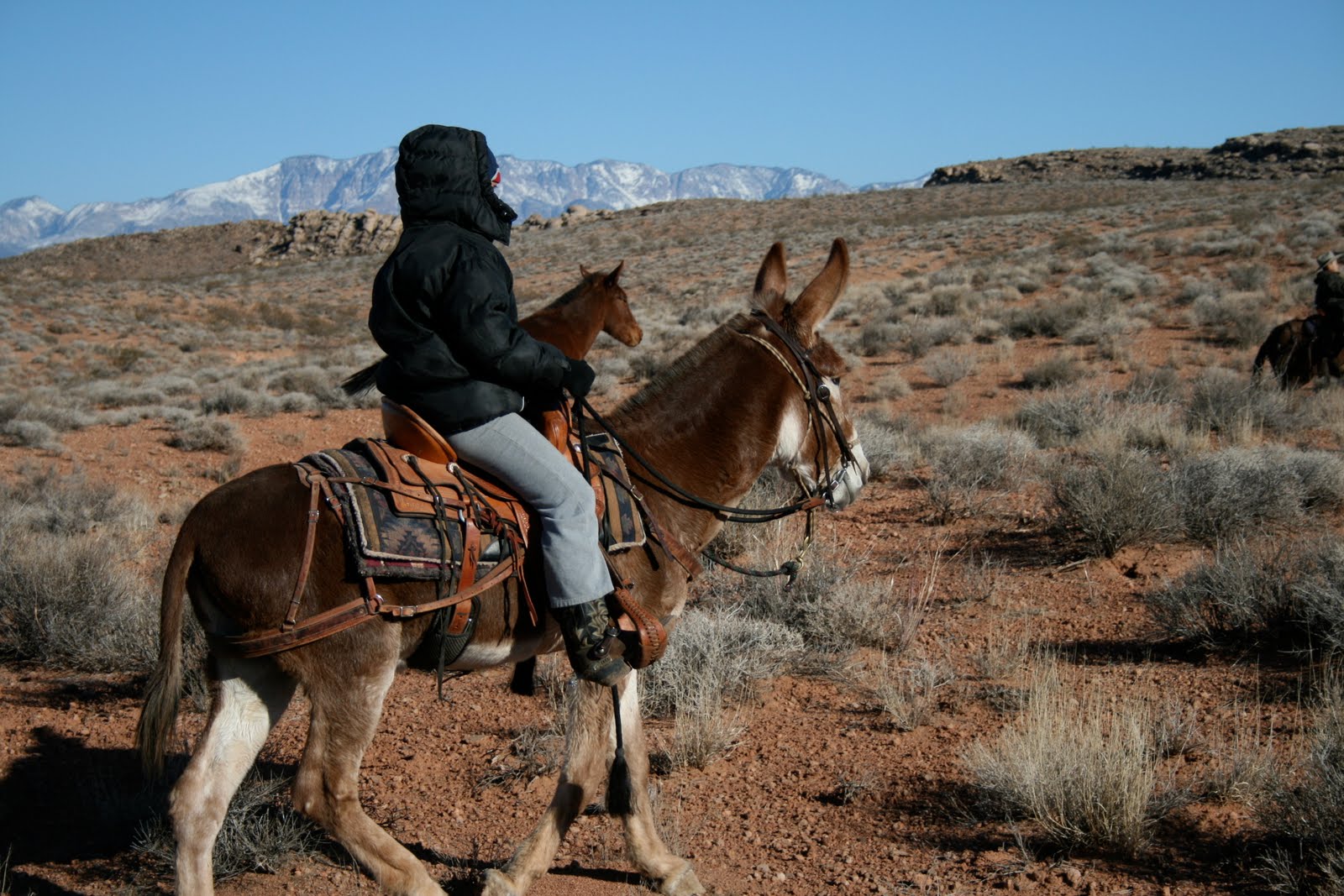
This weekend was a three generation pack trip into Hop Valley. My brother and I took a couple of our boys and my aging father, who just returned from a 2 year absence as a missionary in Alaska, back into our favorite part of Zion National Park. It was many things: Dad hasn't been atop a horse for several decades. Besides a little practice over the past two weeks to get ready for this, two days on my big dunn Molly about wore him out. My five-year-old Preston enjoyed his first real solo trip. He didn't want to come home and would have preferred to stay until we starved him out. Brother Mike and I were breaking Sulpher herd mustangs, him on Allie, and me finishing a 30 day job for some friends on their 2 year old gelding, Rusty.


Before bed, I noticed Senator, the 6 month old mule we brought to tag along was gone. I recently weened him, and had left his momma home. All day he had been with his coral mates and I didn't sense much need to worry. SHOOT! Not again! When these babies want a drink of Milk, they don't care what stands in their way! Sure he was headed home, I saddled my Molly, and headed off into the dark, alone, to find him. Molly's cowbell still fastened to her neck, we climbed out of the canyon's sandy bottoms and up the rocky trail to the top of the Mesa. The moon was about half lit, boldy marking the trail. Cold, clear air filled my lungs and the clank of cowbell sounded in perfect rythm to Molly's stride. The brilliant red cliffs had lost their color, standing gray against the night sky. Senator was up top just where I thought he would be, on his way home to momma. All alone, he was glad to see me, but wasn't in the mood to follow me back. I haltered him and began the long descent back to camp, glad of heart that I didn't lose my little mule in this Lion infested wilderness, glad of ear for the sound of Cowbell, and glad of eye for the light of half a moon to get me down the trail.


Sunday, May 25, 2008

Riding into the Hand of God--Hop Valley


The least known part of Zion National Park is the Kolob Canyon formations at the NorthWest corner of the park. Locally, it is known as the Kolob Fingers for its hand-like topography when seen from above. Flying over the Kolob Fingers is something of a religious experience. Pardon the hyperbole, but the view from above is the most beautiful piece of terra firma on this Earth. Six West-pointing fingers and the South-pointing thumb pictured above, dominate a bewildering tangle of slot, crack, and sheer cliff. I have flown into His grasp several times, the wind in my face, soaring with the raptors on the magic carpet of my Powered Parachute. The spectacle evokes involuntary tears every single time. Its natural beauty causes the soul to recoil, as if transfiguration would be required to withstand the view.


I first disovered Hop Valley on a flight over the fingers. A beautiful narrow valley, lush with grass, and a meandering stream that seemed to emerge from the ground on the south end of the valley and disappear into the ground at the foot of a small mountain on the other. The fingers tower at the north end of the valley, rising 2500 hundred feet above, and across a chasm another 1000 feet below, where Hop Valley's creek re-emerges and empties into LaVerkin Creek. It is a choice peice of real estate surrounded by official park, but still private property. Generations of the Lee family of Virgin Utah have run cows in her verdant meadows. We met Alan and some of the family there last fall while on horseback and helped him round up some strays that had wandered into the Park.


This weekend's weather threatened rain, so we looked forward to our planned overnighter into Hop Valley with great anticipation. Riding and camping in the rain is good practice for our summer wilderness trip, and we love it anyway. Defying nature under hat and slicker is good, raw fun. So, prepared for rain, my two daughters, friend Bruce Jenkins, and I decended into the Valley.


The twin smells of wet pine and spring sage blew coldly against our faces as we rode between the myst-shrouded canyon walls. Weather barking more than biting, we got a few sprinkles on the way in, and a gentle, dry rain that sounded like cannon-fire against our tent the next morning. It spat just enough to discolor the vertical sandstone cliffs and scrub the already-pristine air. At bedtime, the sky cleared and we hunted constellations to the sound of a lonely blues harp and the warmth of a fire.


Life's stream wandering through the straight and narrow, a gateway to the very Hand of God--riding Hop Valley is an allegorical journey, rich with metaphor and spiritual overtones. No wonder the ancients feared and revered this place. I often wonder if the general decline in religiosity can be traced to the loss of our night-time sky and our addiction to pavement. Only the most calloused soul could miss the still small voice, or the lions roar of His love in this place.

Friday, April 4, 2008

The Quickening of time


Life accelerated moves along at a pace that leaves you gasping for breath--its wind hitting you in the face so forcefully, breathing comes in gulps. Months, measured by mortgages and car payments blur by like the dotted center line on life's highway. Years, punctuated by tax season, click along like telephone poles beside that same highway--each one coming before you recover from the last one.

Is time really moving faster, or are we just so busy that it seems like it? In the tradition of the prophets who speak of the latter days, time is to be quickened. I don't know if such a thing is meant to be a physical reality or just a perception, but I found the secret key to slowing time down to a manageable pace.

Just have mule babies. Watching our overdue mare (9 going on 10 days overdue) is worse than watching the grass grow. Each night, we take turns checking on her hourly.

Remember how slow time seemed to move when we were kids? My kids didn't know what that meant until now. And the best part about time slowing down...? I have more of it to get things done than normal. Soon as the baby comes and we get back on the fast train again, we'll be behind as usual.

Tuesday, February 5, 2008

General Washington, what about those genes?

So what is in those genes? The history of the American Mammoth Donkey, now a rare breed, seems sketchy and difficult to discover in sound, peer-reviewed journals or articles. Perhaps there are some dusty books in a library somewhere that contain good information on Mammoth donkey history, but I'm not seeing it in cyberland. Currently, argument exists over whether today's American Mammoth Donkey is even a seperate breed. Perhaps all we have left is the dilute aftermath of Henry Ford's legless invention. For many years after mechanized transportation entered the scene, the Mammoth Jack seemed to disappear from radar and the American landscape.


Breed registries exist that help inform the renewed interest in Mammoth Donkeys, but they are relatively young, somewhat less rigorous than many horse registries, and, I wonder--relatively underutilized? The unique American need that drove the development of certain Mammoth characteristics prior to the industrial era has shifted to a newly unique American need--recreation. Finding the answer to the genenetics quest in the Jack world often requires following the oral traditions of breeders. That doesn't mean the information out there isn't useful, but its veracity is suspect. I think many American breeders of Mammoth Donkeys may just be a little less formal in their approach to breeding than the dollars available in the horse world have demanded of quality horse breeders. The mood among Mammoth breeders may be reflected in the stated thoughts of one such producer that one "can never go wrong with good confirmation and disposition for any animal no matter where they came from."


At one point, the American Mammoth Donkey was considered its own breed. Producers developed it to fit the unique needs of the American farmer, starting with George Washington himself. My web-based search on the subject produced the following abstract from 1917 in the Journal of Animal Science. (For the entire abstract, See http://jas.fass.org/cgi/content/abstract/1917/1/131)


"The American Jack Stock is a distinct breed made by blending imported breeds from Spain, France, and the Islands of the Mediterranean Sea.

"General George Washington was the first breeder in America, and our own Hon. Henry Clay imported and introduced the best obtainable foreign blood. Messrs Young and Everett of Montgomery County, Kentucky, in 1840 imported a great old jack named Mammoth from the Province of Catalonia, Spain. The Leers of Bourbon County imported two famous jacks named Napoleon and Moro Castle. The latter jack and a grandson of Imp. Mammoth went to Tennessee as foundation sires for that state. Later Tennessee breeders became extensive importers from Spain. But the business of importing jack stock ceased some years ago when it was found that the breed of American Jack stock is superior to any similar stock in Europe. (emphasis mine. PG)

"The breed of American Jacks is the product of constructive breeding performed during seventy years mainly by intelligent breeders in Kentucky, and Tennessee, but Missouri is now adding some substantial contributions to the breed." J. J. Hooper and W. S. Anderson,
Kentucky Agricultural Experiment Station


Today's photos reflect 3 generations of Mammoth Jacks, starting with my Rusty above. The next photo in line is of Sugarcreek Oakie, his sire. The last photo is of Oklahoma Diamond, his paternal grandsire--all three fine specimens in my view.


I am ever thankful to George Washinton for fathering this free nation, for I live the American Dream. Whats more? I should like to add kudos to this father of the gentlemen's pursuit of Mammoth Jacks and mules!


Here's an example of what is in my genes. Happy 13th Kailee!! (She can't date until she is 18 and yes I have a gun...or more)

Friday, January 25, 2008

You're the reason our kids are ugly...


Def: MULE (Lat. mulus), a term not unfrequently applied to the produce of any two creatures of different species, and synonymous with hybrid, but in its ordinary acceptation employed to designate the offspring or "cross" between the equine and asinine species. 1911 Encyclopedia Britannica, 11th edition.


Who can find beauty in the mule? I mean, what mother could love the long ears, broom-tail, strange stance, and bucket shaped head on this creature? Whose fault is it? Look at the classy features of its parents. The horse-mother is powerful, muscled and refined with sculptured hips; fine, shapely legs; and a tiny, well-proportioned head. And the stately Jack? His paternal contribution is a magnificent combination of ear, bone, and brain!

Consider the sound the mule makes. It is the most undignified and confusing belch of a sound in all of creation. That sound...it has to be a genetic mistake. The Tarzan-like brilliance of the Jack's tone-clear bray is NOT additive with the horse's polished neigh. This is one example where the combined strength of each parent is not mutually beneficent. The mule's voice is more confused than an armadillo crossing a Mississippi freeway.


I've been the dad around here now for 16 plus years. Our kids exhibit the kind of hybrid vigor one might expect from our marriage--me, a Jackass country kid from Mona making babies with her, a Thoroughbred Khmer Princess from exotic Phnom Penh. Our kids are smart, talented, hard-working children that have supple neck-rein and move quite nicely off of my leg cues. Hopefully they got my pluck. They certainly got her grace. The thing is...we can't figure out who to blame for their looks. Their mother and I just glare at each other and point a BLAMING finger, "You're the reason our kids are ugly!" Even the marriage counselor can't figure out who to blame. I just know its HER fault though...but shhhhhhh. The counselor says I'm supposed to keep those thoughts to myself, be they true or not.
Oh yes..... If you want to hear the voice of the Mona/Phnom Penh mule hybrid, come around chore time. It is the most haunting rendition of Gloom, Despair, and Agony you’ll ever hear. I love the Mule project growing in my backyard!


Monday, January 21, 2008

Why Mules? A little Mystique...


Mule is a term that describes any type of hybrid cross (plant or animal), the most common of which is the product of a horse and a donkey. The product of this cross inherits its brains and tenacity from the donkey parent, and its power and athleticism from the horse parent. This long-eared hybrid is adored or scorned among equine lovers--but seldom will you hear the subject discussed in nuetral terms. Love it or hate it, the mule made America. She farmed our land, hauled our lumber, drained our swamps, took us to church and war. From my youth, stories of the mule informed my fascination and I hope to share a few of those over time--from Porter Rockwells famed ability to capture outlaws by mule, to the Borax 20 mule team.
Here are some nuggets to bait your own curiosity:

George Washington played a major role in the development of the Mule in America. He was an excellent horseman, but felt horses "ate too much, worked too little, and died too young". In order to obtain an animal that better suited his needs, Washington imported jackstock from Spain and France to start his mule breeding program.

Between 1883 and 1889, a few twenty-mule teams hauled more than 20 million pounds of borax out of Death Valley for the Borax company. During this time, not a single animal was lost, a considerable tribute to the stamina and smarts of mules when you account for the heat, hairpin turns and rugged terrain they had to endure over the 10 day, 330 mile round trip. Borax's 20 mule team has since become its own historical icon.

During the frontier years, Missouri was the leading producer of quality mules. For a time, 45% of all farms in Missouri produced or used mules.

Mules and the quality jackstock that produced them nearly faded into the annals of history after the car and mechanized farm equipment entered the scene. A few enthusiasts began the process of restoring the breeds in the late 1960s and early 1970s. An increase in mule popularity, particularly over the last ten years, has fostered a dramatic improvement in the quality of saddle mules by improved quality jackstock, careful breeding to foundation horsestock, and the formation of registries to help breeders target desired genetic traits.

Mules are stronger than horses of similar size and have considerably greater stamina, making them ideal pack animals. Their reputation for being stubborn comes from their heightened sense of self preservation- they can't be readily fooled or goaded into putting themselves at risk. Concessionaires in the Grand Canyon have a 100 percent safety record with their mules taking inexperienced riders into the canyon along its narrow, cliffy trails. Consider the following interesting points about mules:


  • Legend says they live longer than horses (up to 30 and 40 plus years)

  • Fact says they cannot reproduce, but there may be exceptions (Donkeys have 62 chromosomes, and horses have 64; leaving Mules with 63, an odd number, and therefore sterile)

  • Legend says they can work harder for longer and do it with less food or water. On average you can feed 2 mules for every horse.

  • They can clear 7 to 8 feet from a standing jump--commonly measured feats in competitions around the country.

  • Legend says they have thicker skin and are more resistant to HEAT, cold, and the elements

  • Their hooves are better suited to rugged, ledgy country.

  • Personal experience says they are VERY intelligent, show enhanced personality, and form more of a bond with humans than horses--on the flip side, they don't easily forgive or forget.


Todays quality mules compete in every equine sport--from racing to calf roping to Dressage. They come in every imaginable variety--from thoroughbred racing types to quarter horse saddle types to the very proper Tennesee Walker mule. Well trained, quality mules tend to hold above average value--even with this year's softening of the horse market. Properly trained, well bred mules are still a challenge to find, in my opinion. The best mules are often traded amongst acquaintances and never see the open market according to many insiders I have queried.

In my own quest to find good mules for my family, I settled on making my own after serendipitously finding a superior quality StudJack out of Missouri named Utah Scooter Rusty Sugarcreek, or just "Rusty."